

Nvidia Geforce Gtx 660 Or Equivalent
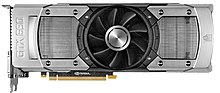 GeForce GTX 690 released in 2012, the series' flagship unit | |
| Release date | March 22, 2012 (March 22, 2012) |
|---|---|
| Codename | GK10x |
| Architecture | Kepler |
| Models | GeForce series
|
| Transistors | 292M 40 nm (GF119)
|
| Cards | |
| Entry-level |
|
| Mid-range |
|
| High-finish |
|
| Enthusiast |
|
| API support | |
| Direct3D | Direct3D 12.0 (feature level 11_0)[one] |
| OpenCL | OpenCL 1.2[ii] |
| OpenGL | OpenGL iv.6 |
| Vulkan | Vulkan 1.two[3] SPIR-5 |
| History | |
| Predecessor | GeForce 500 serial |
| Successor |
|
Serving every bit the introduction of Kepler architecture, the GeForce 600 serial is a series of graphics processing units adult by Nvidia, first released in 2012.
Overview [edit]
Where the goal of the previous compages, Fermi, was to increase raw performance (peculiarly for compute and tessellation), Nvidia's goal with the Kepler architecture was to increase performance per watt, while nevertheless striving for overall functioning increases.[4] The main style Nvidia accomplished this goal was through the use of a unified clock. By abandoning the shader clock found in their previous GPU designs, efficiency is increased, even though it requires more cores to achieve similar levels of performance. This is not only because the cores are more power efficient (ii Kepler cores using about ninety% of the power of one Fermi core, according to Nvidia'south numbers), merely as well because the reduction in clock speed delivers a fifty% reduction in ability consumption in that area.[v]
Kepler as well introduced a new course of texture handling known as bindless textures. Previously, textures needed to exist leap by the CPU to a particular slot in a stock-still-size table before the GPU could reference them. This led to two limitations: ane was that because the tabular array was fixed in size, in that location could only be as many textures in use at one time every bit could fit in this tabular array (128). The second was that the CPU was doing unnecessary work: it had to load each texture, and also demark each texture loaded in retention to a slot in the binding table.[iv] With bindless textures, both limitations are removed. The GPU can access any texture loaded into memory, increasing the number of bachelor textures and removing the functioning penalty of binding.
Finally, with Kepler, Nvidia was able to increase the memory clock to 6 GHz. To reach this, Nvidia needed to design an entirely new retention controller and bus. While still shy of the theoretical 7 GHz limitation of GDDR5, this is well in a higher place the iv GHz speed of the memory controller for Fermi.[v]
Kepler is named afterwards the German language mathematician, astronomer, and astrologer Johannes Kepler.
Compages [edit]

Asus Nvidia GeForce GTX 650 Ti, a PCI Express three.0 ×16 graphics card
The GeForce 600 series contains products from both the older Fermi and newer Kepler generations of Nvidia GPUs. Kepler based members of the 600 series add together the following standard features to the GeForce family:
- PCI Express 3.0 interface
- DisplayPort one.2
- HDMI i.4a 4K x 2K video output
- Purevideo VP5 hardware video acceleration (up to 4K x 2K H.264 decode)
- Hardware H.264 encoding acceleration block (NVENC)
- Support for up to 4 independent 2D displays, or iii stereoscopic/3D displays (NV Surround)
- Side by side Generation Streaming Multiprocessor (SMX)
- A New Didactics Scheduler
- Bindless Textures
- CUDA Compute Capability 3.0
- GPU Boost
- TXAA
- Manufactured by TSMC on a 28 nm process
Streaming Multiprocessor Compages (SMX) [edit]
The Kepler architecture employs a new Streaming Multiprocessor Compages called SMX. The SMX are the key method for Kepler's ability efficiency every bit the whole GPU uses a single "Core Clock" rather than the double-pump "Shader Clock".[5] The SMX usage of a unmarried unified clock increases the GPU ability efficiency due to the fact that two Kepler CUDA Cores consume ninety% power of 1 Fermi CUDA Cadre. Consequently, the SMX needs additional processing units to execute a whole warp per wheel. Kepler also needed to increase raw GPU functioning equally to remain competitive. As a result, information technology doubled the CUDA Cores from 16 to 32 per CUDA assortment, 3 CUDA Cores Array to half dozen CUDA Cores Array, 1 load/store and 1 SFU group to two load/store and 2 SFU group. The GPU processing resources are also double. From 2 warp schedulers to iv warp schedulers, four dispatch unit became 8 and the register file doubled to 64K entries equally to increment performance. With the doubling of GPU processing units and resources increasing the usage of die spaces, The adequacy of the PolyMorph Engine aren't double but enhanced, making it capable of spurring out a polygon in 2 cycles instead of four.[six] With Kepler, Nvidia non only worked on power efficiency but likewise on area efficiency. Therefore, Nvidia opted to utilise eight defended FP64 CUDA cores in a SMX as to save die space, while yet offering FP64 capabilities since all Kepler CUDA cores are not FP64 capable. With the comeback Nvidia fabricated on Kepler, the results include an increase in GPU graphic performance while downplaying FP64 functioning.
A new instruction scheduler [edit]
Additional die areas are acquired by replacing the circuitous hardware scheduler with a simple software scheduler. With software scheduling, warps scheduling was moved to Nvidia'south compiler and as the GPU math pipeline now has a stock-still latency, information technology now include the utilization of instruction-level parallelism and superscalar execution in improver to thread-level parallelism. As instructions are statically scheduled, scheduling inside a warp becomes redundant since the latency of the math pipeline is already known. This resulted an increment in die expanse space and ability efficiency.[v] [7] [iv]
GPU Boost [edit]
GPU Heave is a new feature which is roughly coordinating to turbo boosting of a CPU. The GPU is always guaranteed to run at a minimum clock speed, referred to as the "base clock". This clock speed is set to the level which will ensure that the GPU stays within TDP specifications, even at maximum loads.[iv] When loads are lower, nonetheless, there is room for the clock speed to exist increased without exceeding the TDP. In these scenarios, GPU Heave will gradually increase the clock speed in steps, until the GPU reaches a predefined power target (which is 170W past default).[5] Past taking this arroyo, the GPU volition ramp its clock up or down dynamically, so that it is providing the maximum corporeality of speed possible while remaining inside TDP specifications.
The ability target, as well as the size of the clock increase steps that the GPU will take, are both adjustable via third-party utilities and provide a ways of overclocking Kepler-based cards.[4]
Microsoft DirectX back up [edit]
Both Fermi and Kepler based cards support Direct3D eleven, both also support Direct3D 12, though not all features provided past the API.[8] [9]
TXAA [edit]
Exclusive to Kepler GPUs, TXAA is a new anti-aliasing method from Nvidia that is designed for direct implementation into game engines. TXAA is based on the MSAA technique and custom resolve filters. Its design addresses a key problem in games known equally shimmering or temporal aliasing; TXAA resolves that by smoothing out the scene in move, making certain that any in-game scene is beingness cleared of any aliasing and shimmering.[10]
NVENC [edit]
NVENC is Nvidia's SIP cake that performs video encoding, in a way similar to Intel's Quick Sync Video and AMD's VCE. NVENC is a power-efficient stock-still-function pipeline that is able to accept codecs, decode, preprocess, and encode H.264-based content. NVENC specification input formats are limited to H.264 output. Simply yet, NVENC, through its express format, can perform encoding in resolutions up to 4096×4096.[11]
Like Intel's Quick Sync, NVENC is currently exposed through a proprietary API, though Nvidia does have plans to provide NVENC usage through CUDA.[11]
New driver features [edit]
In the R300 drivers, released alongside the GTX 680, Nvidia introduced a new feature called Adaptive VSync. This feature is intended to gainsay the limitation of 5-sync that, when the framerate drops beneath 60 FPS, there is stuttering as the 5-sync charge per unit is reduced to thirty FPS, then down to further factors of 60 if needed. However, when the framerate is below 60 FPS, in that location is no need for five-sync as the monitor will be able to display the frames as they are ready. To accost this result (while even so maintaining the advantages of 5-sync with respect to screen fierce), Adaptive VSync can be turned on in the commuter command console. Information technology will enable VSync if the framerate is at or to a higher place 60 FPS, while disabling it if the framerate lowers. Nvidia claims that this will result in a smoother overall brandish.[four]
While the characteristic debuted aslope the GTX 680, this feature is available to users of older Nvidia cards who install the updated drivers.[4]
Dynamic Super Resolution (DSR) was added to Fermi and Kepler GPUs with an October 2014 release of Nvidia drivers. This feature aims at increasing the quality of displayed picture, by rendering the scenery at a college and more detailed resolution (upscaling), and scaling information technology down to friction match the monitor'southward native resolution (downsampling).[12]
History [edit]
In September 2010, Nvidia first announced Kepler.[13]
In early 2012, details of the first members of the 600 series parts emerged. These initial members were entry-level laptop GPUs sourced from the older Fermi compages.
On March 22, 2012, Nvidia unveiled the 600 series GPU: the GTX 680 for desktop PCs and the GeForce GT 640M, GT 650M, and GTX 660M for notebook/laptop PCs.[14] [15]
On April 29, 2012, the GTX 690 was announced as the first dual-GPU Kepler product.[sixteen]
On May 10, 2012, the GTX 670 was officially announced.[17]
On June 4, 2012, the GTX 680M was officially announced.[eighteen]
On August 16, 2012, the GTX 660 Ti was officially announced.[nineteen]
On September 13, 2012, the GTX 660 and GTX 650 were officially announced.[xx]
On October 9, 2012, the GTX 650 Ti was officially announced.[21]
On March 26, 2013, the GTX 650 Ti Boost was officially appear.[22]
Products [edit]
GeForce 600 (6xx) serial [edit]

- 1 SPs – Shader Processors – Unified Shaders : Texture mapping units : Render output units
- 2 The GeForce 605 (OEM) menu is a rebranded GeForce 510.
- 3 The GeForce GT 610 carte du jour is a rebranded GeForce GT 520.
- iv The GeForce GT 620 (OEM) card is a rebranded GeForce GT 520.
- 5 The GeForce GT 620 card is a rebranded GeForce GT 530.
- half dozen This revision of GeForce GT 630 (DDR3) card is a rebranded GeForce GT 440 (DDR3).
- 7 The GeForce GT 630 (GDDR5) card is a rebranded GeForce GT 440 (GDDR5).
- viii The GeForce GT 640 (OEM) carte du jour is a rebranded GeForce GT 545 (DDR3).
- 9 The GeForce GT 645 (OEM) card is a rebranded GeForce GTX 560 SE.
| Model | Launch | Lawmaking Proper name | Fab (nm) | Transistors (Million) | Die size (mmtwo) | Bus interface | SM Count | Cadre Configuration1 | Clock Rate | Fillrate | Memory Configuration | API Back up (version) | GFLOPS (FMA) | TDP (Watts) | Launch Price (USD) | |||||||||||
|---|---|---|---|---|---|---|---|---|---|---|---|---|---|---|---|---|---|---|---|---|---|---|---|---|---|---|
| Core (MHz) | Average Heave (MHz) | Max. Boost (MHz) | Shader (MHz) | Memory (MHz) | Pixel (GP/s) | Texture (GT/southward) | Size (MB) | Bandwidth (GB/southward) | DRAM Type | Bus Width (bit) | DirectX | OpenGL | OpenCL | Vulkan | ||||||||||||
| GeForce 605ii | Apr iii, 2012 | GF119 | 40 | 292 | 79 | PCIe ii.0 x16 | 1 | 48:8:4 | 523 | — | — | 1046 | 1798 | 2.1 | 4.three | 512 1024 | 14.4 | DDR3 | 64 | 12.0 (11_0) | iv.6 | 1.ane | — | 100.4 | 25 | OEM |
| GeForce GT 610three | May 15, 2012 | GF119-300-A1 | PCIe 2.0 x16, PCI | 810 | 1620 | 1800 | 3.24 | vi.5 | 1024 2048 | 155.5 | 29 | Retail | ||||||||||||||
| GeForce GT 620iv | April iii, 2012 | GF119 | 292 | PCIe 2.0 x16 | 1798 | 512 1024 | 30 | OEM | ||||||||||||||||||
| GeForce GT 6205 | May xv, 2012 | GF108-100-KB-A1 | 585 | 116 | 2 | 96:16:4 | 700 | 1400 | 1800 | ii.viii | 11.2 | 1024 | 268.eight | 49 | Retail | |||||||||||
| GeForce GT 625 | February 19, 2013 | GF119 | 292 | 79 | 1 | 48:viii:iv | 810 | 1620 | 1798 | three.24 | 6.5 | 512 1024 | 155.five | 30 | OEM | |||||||||||
| GeForce GT 630 | Apr 24, 2012 | GK107 | 28 | 1300 | 118 | PCIe three.0 x16 | 192:sixteen:sixteen | 875 | 875 | 1782 | 7 | fourteen | 1024 2048 | 28.5 | 128 | 1.2 | ? | 336 | fifty | |||||||
| GeForce GT 630 (DDR3)half-dozen | May 15, 2012 | GF108-400-A1 | twoscore | 585 | 116 | PCIe 2.0 x16 | ii | 96:16:4 | 810 | 1620 | 1800 | 3.2 | xiii | 1024 2048 4096 | 28.8 | 1.1 | — | 311 | 65 | Retail | ||||||
| GeForce GT 630 (Rev. 2) | May 29, 2013 | GK208-301-A1 | 28 | 1270 | 79 | PCIe 2.0 x8 | 384:16:8 | 902 | 902 | vii.22 | 14.four | 1024 2048 | 14.four | 64 | 1.2 | ? | 692.7 | 25 | ||||||||
| GeForce GT 630 (GDDR5)7 | May 15, 2012 | GF108 | 40 | 585 | 116 | PCIe 2.0 x16 | 96:xvi:4 | 810 | 1620 | 3200 | 3.2 | xiii | 1024 | 51.2 | GDDR5 | 128 | 1.1 | — | 311 | 65 | Retail | |||||
| GeForce GT 635 | February 19, 2013 | GK208 | 28 | 79 | PCIe 3.0 x16 | 1 | 192:xvi:sixteen | 875 | 875 | 1782 | 7 | 14 | 1024 2048 | 28.5 | DDR3 | one.2 | 1.1 | 336 | l | OEM | ||||||
| GeForce GT 6408 | Apr 24, 2012 | GF116-150-A1 | xl | 1170 | 238 | PCIe 2.0 x16 | iii | 144:24:24 | 720 | 1440 | 4.3 | 17.three | 1536 3072 | 42.8 | 192 | 1.1 | — | 414.7 | 75 | |||||||
| GeForce GT 640 (DDR3) | Apr 24, 2012 | GK107-301-A2 | 28 | 1300 | 118 | PCIe 3.0 x16 | 2 | 384:32:16 | 797 | 797 | 12.eight | 25.5 | 1024 2048 | 28.five | 128 | 1.two | ? | 612.1 | fifty | |||||||
| GeForce GT 640 (DDR3) | June five, 2012 | GK107-300-A2 | 118 | 900 | 900 | fourteen.4 | 28.8 | 1024[23] 2048 | 691.2 | 65 | $100 | |||||||||||||||
| GeForce GT 640 (GDDR5) | April 24, 2012 | GK107 | 118 | 950 | 950 | 5000 | 15.2 | 30.iv | 1024 2048 | 80 | GDDR5 | 729.six | 75 | OEM | ||||||||||||
| GeForce GT 640 Rev. 2 | May 29, 2013 | GK208-400-A1 | 1270 | 79 | PCIe 2.0 x8 | 384:16:8 | 1046 | 1046 | 5010 | eight.37 | 16.7 | 1024 | 40.1 | 64 | 803.three | 49 | ||||||||||
| GeForce GT 6459 | April 24, 2012 | GF114-400-A1 | twoscore | 1950 | 332 | PCIe 2.0 x16 | vi | 288:48:24 | 776 | 1552 | 3828 | eighteen.6 | 37.3 | 91.9 | 192 | i.ane | — | 894 | 140 | OEM | ||||||
| GeForce GTX 645 | April 22, 2013 | GK106 | 28 | 2540 | 221 | PCIe three.0 x16 | three | 576:48:xvi | 823.5 | 888.five | 823 | 4000 | ix.88 | 39.v | 64 | 128 | 1.2 | ? | 948.1 | 64 | ||||||
| GeForce GTX 650 | September xiii, 2012 | GK107-450-A2 | 1300 | 118 | two | 384:32:16 | 1058 | — | 1058 | 5000 | 16.ix | 33.viii | 1024 2048 | 80 | 1.1 | 812.5 | 64 | $110 | ||||||||
| GeForce GTX 650 Ti | October 9, 2012 | GK106-220-A1 | 2540 | 221 | 4 | 768:64:16 | 928 | 928 | 5400 | fourteen.8 | 59.2 | 86.iv | 1420.viii | 110 | $150 | |||||||||||
| GK106-225-A1 | ||||||||||||||||||||||||||
| GeForce GTX 650 Ti Boost | March 26, 2013 | GK106-240-A1 | 768:64:24 | 980 | 1033 | 980 | 6002 | 23.5 | 62.7 | 1024 2048 | 144.2 | 192 | 1505.28 | 134 | $170 | |||||||||||
| GeForce GTX 660[24] | September 13, 2012 | GK106-400-A1 | 5 | 960:80:24 | 1084 | 6000 | 78.5 | 2048 3072 | 1881.half dozen | 140 | $230 | |||||||||||||||
| GeForce GTX 660 (OEM[25]) | August 22, 2012 | GK104-200-KD-A2 | 3540 | 294 | 6 | 1152:96:24 1152:96:32 | 823 | 888 | Unknown | 823 | 5800 | 19.8 | 79 | 1536 2048 | 134 | 192 256 | 2108.6 | 130 | OEM | |||||||
| GeForce GTX 660 Ti | Baronial 16, 2012 | GK104-300-KD-A2 | 294 | 7 | 1344:112:24 | 915 | 980 | 1058 | 915 | 6008 | 22.0 | 102.5 | 2048 3072 | 144.ii | 192 | 2460 | 150 | $300 | ||||||||
| GeForce GTX 670 | May 10, 2012 | GK104-325-A2 | 294 | 1344:112:32 | 1084 | 29.3 | 2048 4096 | 192.256 | 256 | 170 | $400 | |||||||||||||||
| GeForce GTX 680 | March 22, 2012 | GK104-400-A2 | 294 | viii | 1536:128:32 | 1006[4] | 1058 | 1110 | 1006 | 32.2 | 128.8 | 3090.4 | 195 | $500 | ||||||||||||
| GeForce GTX 690 | April 29, 2012 | 2× GK104-355-A2 | 2× 3540 | 2× 294 | 2× 8 | 2× 1536:128:32 | 915 | 1019 | 1058[26] | 915 | two× 29.28 | 2× 117.12 | 2× 2048 | 2× 192.256 | 2× 256 | 2× 2810.88 | 300 | $1000 | ||||||||
| Model | Launch | Code Name | Fab (nm) | Transistors (1000000) | Die size (mmtwo) | Bus interface | SM Count | Core Configuration 1 | Clock Charge per unit | Fillrate | Memory Configuration | API Support (version) | GFLOPS (FMA) | TDP (Watts) | Launch Price (USD) | |||||||||||
| Cadre (MHz) | Average Boost (MHz) | Max. Heave (MHz) | Shader (MHz) | Memory (MHz) | Pixel (GP/s) | Texture (GT/southward) | Size (MiB) | Bandwidth (GB/southward) | DRAM Type | Bus Width (bit) | DirectX | OpenGL | OpenCL | Vulkan | ||||||||||||
GeForce 600M (6xxM) series [edit]
The GeForce 600M serial for notebooks architecture. The processing power is obtained by multiplying shader clock speed, the number of cores and how many instructions the cores are capable of performing per wheel.
- 1 Unified Shaders : Texture mapping units : Render output units
| Model | Launch | Lawmaking Name | Fab (nm) | Autobus interface | Core Configurationane | Clock Speed | Fillrate | Retentiveness | API Support (version) | Processing Ability2 (GFLOPS) | TDP (Watts) | Notes | |||||||||
|---|---|---|---|---|---|---|---|---|---|---|---|---|---|---|---|---|---|---|---|---|---|
| Core (MHz) | Shader (MHz) | Memory (MT/s) | Pixel (GP/s) | Texture (GT/s) | Size (MiB) | Bandwidth (GB/south) | DRAM Type | Coach Width (bit) | DirectX | OpenGL | OpenCL | Vulkan | |||||||||
| GeForce 610M [27] | December 2011 | GF119 (N13M-GE) | forty | PCIe ii.0 x16 | 48:eight:4 | 450 | 900 | 1800 | iii.half-dozen | seven.2 | 1024 2048 | 14.4 | DDR3 | 64 | 12.0 (11_0) | iv.half dozen | 1.i | — | 142.08 | 12 | OEM. Rebadged GT 520MX |
| GeForce GT 620M [28] | Apr 2012 | GF117 (N13M-GS) | 28 | 96:16:4 | 625 | 1250 | 1800 | 2.5 | 10 | 14.4 28.8 | 64 128 | 240 | 15 | OEM. Dice-Shrink GF108 | |||||||
| GeForce GT 625M | October 2012 | GF117 (N13M-GS) | 14.four | 64 | |||||||||||||||||
| GeForce GT 630M[28] [29] [30] | Apr 2012 | GF108 (N13P-GL) GF117 | twoscore 28 | 660 800 | 1320 1600 | 1800 4000 | ii.six 3.2 | ten.vii 12.viii | 28.8 32.0 | DDR3 GDDR5 | 128 64 | 258.0 307.two | 33 | GF108: OEM. Rebadged GT 540M GF117: OEM Die-Compress GF108 | |||||||
| GeForce GT 635M[28] [31] [32] | Apr 2012 | GF106 (N12E-GE2) GF116 | forty | 144:24:24 | 675 | 1350 | 1800 | 16.ii | 16.2 | 2048 1536 | 28.viii 43.2 | DDR3 | 128 192 | 289.2 388.viii | 35 | GF106: OEM. Rebadged GT 555M GF116: 144 Unified Shaders | |||||
| GeForce GT 640M LE[28] | March 22, 2012 | GF108 GK107 (N13P-LP) | 40 28 | PCIe 2.0 x16 PCIe 3.0 x16 | 96:16:4 384:32:16 | 762 500 | 1524 500 | 3130 1800 | 3 viii | 12.ii 16 | 1024 2048 | 50.two 28.eight | GDDR5 DDR3 | 128 | 1.1 ane.2 | N/A ? | 292.6 384 | 32 xx | GF108: Fermi GK107: Kepler architecture | ||
| GeForce GT 640M[28] [33] | March 22, 2012 | GK107 (N13P-GS) | 28 | PCIe three.0 x16 | 384:32:16 | 625 | 625 | 1800 4000 | 10 | xx | 28.8 64.0 | DDR3 GDDR5 | 1.2 | one.1 | 480 | 32 | Kepler architecture | ||||
| GeForce GT 645M | Oct 2012 | GK107 (N13P-GS) | 710 | 710 | 1800 4000 | 11.36 | 22.72 | 545 | |||||||||||||
| GeForce GT 650M[28] [34] [35] | March 22, 2012 | GK107 (N13P-GT) | 835 745 900* | 835 745 900* | 1800 4000 5000* | 13.4 11.ix 14.4* | 26.7 23.eight 28.8* | 28.8 64.0 lxxx.0* | 641.3 572.2 691.2* | 45 | Kepler compages * | ||||||||||
| GeForce GTX 660M[28] [35] [36] [37] | March 22, 2012 | GK107 (N13E-GE) | 835 | 835 | 5000 | 13.4 | 26.7 | 2048 | 80.0 | GDDR5 | 641.3 | 50 | Kepler architecture | ||||||||
| GeForce GTX 670M[28] | April 2012 | GF114 (N13E-GS1-LP) | forty | PCIe 2.0 x16 | 336:56:24 | 598 | 1196 | 3000 | 14.35 | 33.5 | 1536 3072 | 72.0 | 192 | 1.ane | — | 803.six | 75 | OEM. Rebadged GTX 570M | |||
| GeForce GTX 670MX | October 2012 | GK106 (N13E-GR) | 28 | PCIe iii.0 x16 | 960:80:24 | 600 | 600 | 2800 | 14.4 | 48.0 | 67.2 | 1.2 | i.1 | 1152 | Kepler compages | ||||||
| GeForce GTX 675M[28] | April 2012 | GF114 (N13E-GS1) | forty | PCIe 2.0 x16 | 384:64:32 | 620 | 1240 | 3000 | 19.viii | 39.7 | 2048 | 96.0 | 256 | i.1 | ? | 952.3 | 100 | OEM. Rebadged GTX 580M | |||
| GeForce GTX 675MX | October 2012 | GK106 (N13E-GSR) | 28 | PCIe iii.0 x16 | 960:80:32 | 600 | 600 | 3600 | 19.2 | 48.0 | 4096 | 115.2 | 1.two | one.ane | 1152 | Kepler compages | |||||
| GeForce GTX 680M | June 4, 2012 | GK104 (N13E-GTX) | 1344:112:32 | 720 | 720 | 3600 | 23 | 80.6 | 1935.4 | ||||||||||||
| GeForce GTX 680MX | October 23, 2012 | GK104 | 1536:128:32 | 5000 | 92.2 | 160 | 2234.iii | 100+ | |||||||||||||
| Model | Launch | Code Name | Fab (nm) | Bus interface | Core Configuration1 | Clock Speed | Fillrate | Retention | API Support (version) | Processing Power2 (GFLOPS) | TDP (Watts) | Notes | |||||||||
| Core (MHz) | Shader (MHz) | Memory (MT/south) | Pixel (GP/s) | Texture (GT/s) | Size (MiB) | Bandwidth (GB/due south) | DRAM Blazon | Motorcoach Width (bit) | DirectX | OpenGL | OpenCL | Vulkan | |||||||||
Chipset table [edit]
Discontinued support [edit]
Nvidia announced that after Release 390 drivers, it volition no longer release 32-chip drivers for 32-bit operating systems.[38]
Nvidia announced that Kepler notebook GPUs will transition to legacy support from April 2019 onwards and be supported for critical security updates merely until April 2020.[39] Several of notebook Geforce 6xxM GPUs are affected by this change, the remaining ones being low-cease Fermi GPUs already out of support since January 2019.[40]
Nvidia appear that after Release 470 drivers, it would transition driver support for the Windows 7 and Windows eight.ane operating systems to legacy condition and continue to provide critical security updates for these operating systems through September 2024.[41]
Nvidia announced that all remaining Kepler desktop GPUs would transition to legacy support from September 2021 onwards and be supported for critical security updates through September 2024.[42] All remaining GeForce 6xx GPUs would be affected by this change.
See also [edit]
- List of Nvidia graphics processing units
- GeForce 400 series
- GeForce 500 serial
- GeForce 700 serial
- GeForce 800M series
- GeForce 900 series
- GeForce x series
- Nvidia Quadro
- Nvidia Tesla
References [edit]
- ^ "DX12 Do's and Don'ts". September 17, 2015.
- ^ "NVIDIA GeForce GTX 680 performance in CompuBench - performance benchmark for various compute APIs (OpenCL, RenderScript)".
- ^ "Vulkan Driver Support". Nvidia. Feb 10, 2016. Retrieved Apr 25, 2018.
- ^ a b c d eastward f g h "NVIDIA GeForce GTX 680 Whitepaper.pdf" (PDF). Archived from the original (PDF) on April 17, 2012. ( 1405KB), folio 6 of 29
- ^ a b c d eastward Smith, Ryan (March 22, 2012). "NVIDIA GeForce GTX 680 Review: Retaking The Performance Crown". AnandTech . Retrieved Nov 25, 2012.
- ^ "GK104: The Chip And Architecture GK104: The Chip And Compages". Tom;s Hardware. March 22, 2012.
- ^ "NVIDIA Kepler GK110 Compages Whitepaper" (PDF).
- ^ Moreton, Henry (March 20, 2014). "DirectX 12: A Major Stride for Gaming". Blogs.nvidia.com. Retrieved May eleven, 2014.
- ^ Kowaliski, Cyril (March 21, 2014). "DirectX 12 will likewise add new features for side by side-gen GPUs". The Tech Report . Retrieved April 1, 2014.
- ^ "Introducing The GeForce GTX 680 GPU". Nvidia. March 22, 2012.
- ^ a b "Benchmark Results: NVEnc And MediaEspresso 6.5". Tom's Hardware. March 22, 2012.
- ^ "GeForce Game Gear up Driver For Civilisation: Beyond Earth & Lords Of The Fallen Bachelor Now". Retrieved October 24, 2014.
- ^ Yam, Marcus (September 22, 2010). "Nvidia roadmap". Tom's Hardware United states.
- ^ "Introducing The GeForce GTX 680 GPU". NVIDIA. March 22, 2012. Retrieved Dec 10, 2015.
- ^ "GeForce 600M Notebooks: Powerful and Efficient". NVIDIA. March 21, 2012. Retrieved Dec ten, 2015.
- ^ "Performance Perfected: Introducing the GeForce GTX 690". GeForce. April i, 2012. Retrieved March 1, 2014.
- ^ "Introducing The GeForce GTX 670 GPU". GeForce. March 19, 2012. Retrieved March 1, 2014.
- ^ "Introducing The GeForce GTX 680M Mobile GPU". June iv, 2012. Retrieved December 10, 2015.
- ^ "Come across Your New Weapon: The GeForce GTX 660 Ti. Borderlands 2 Included". GeForce. August fifteen, 2012. Retrieved March 1, 2014.
- ^ "Kepler For Every Gamer: Meet The New GeForce GTX 660 & 650". GeForce. September 12, 2012. Retrieved March 1, 2014.
- ^ "Kepler Family Complete : Introducing the GeForce GTX 650 Ti". GeForce. Oct nine, 2012. Retrieved March 1, 2014.
- ^ "GTX 650 Ti BOOST: Tuned For Sweet Spot Gaming". GeForce. March 26, 2013. Retrieved March 1, 2014.
- ^ "Graphics Cards - GT640-1GD3-L - ASUS Global". asus.com . Retrieved April 10, 2015.
- ^ "Test: NVIDIA GeForce GTX 660". Hardwareluxx.com. September 13, 2012. Archived from the original on September 22, 2012. Retrieved May vii, 2013.
- ^ "GeForce GTX 660 (OEM)". GeForce.com. Retrieved September xiii, 2012.
- ^ "NVIDIA GeForce GTX 690 Review: Ultra Expensive, Ultra Rare, Ultra Fast". AnandTech. Retrieved May vii, 2013.
- ^ "GeForce 610M Graphics Carte du jour with Optimus applied science | NVIDIA". Nvidia.in. Retrieved May 7, 2013.
- ^ a b c d e f one thousand h i "NVIDIA'due south GeForce 600M Series: Mobile Kepler and Fermi Die Shrinks". AnandTech. Retrieved May 7, 2013.
- ^ "GeForce GT 630M Graphics Card with Optimus technology | NVIDIA". Nvidia.in. Retrieved May 7, 2013.
- ^ "GT 630M GPU with NVIDIA Optimus Technology". GeForce. Retrieved May 7, 2013.
- ^ "GeForce GT 635M GPU with NVIDIA Optimus technology | NVIDIA". Nvidia.in. Retrieved May 7, 2013.
- ^ "GT 635M GPU with NVIDIA Optimus Engineering science". GeForce. Retrieved May 7, 2013.
- ^ "Acer Aspire TimelineU M3: Life on the Kepler Verge". AnandTech. Retrieved May seven, 2013.
- ^ "HP Lists New Ivy Span 2012 Mosaic Pattern Laptops, Available April 8th". Laptopreviews.com. March 18, 2012. Archived from the original on May 23, 2013. Retrieved May seven, 2013.
- ^ a b "Help Me Cull | Dell". Content.dell.com. Apr 13, 2012. Archived from the original on November 2, 2012. Retrieved May 7, 2013.
- ^ Wollman, Dana (Jan eight, 2012). "Lenovo unveils six mainstream consumer laptops (and one desktop replacement)". Engadget.com. Retrieved May seven, 2013.
- ^ "660m power describe tested in Asus G75VW". Retrieved Oct 24, 2014.
- ^ "Support Program for 32-bit and 64-bit Operating Systems | NVIDIA".
- ^ "Support Plan for Kepler-series GeForce GPUs for notebooks | NVIDIA".
- ^ "Support Programme for Fermi series GeForce GPUs | NVIDIA".
- ^ "Back up Plan for Windows 7 and Windows 8/8.1 | NVIDIA".
- ^ "Back up Plan for Kepler-series GeForce GPUs for Desktop | NVIDIA".
External links [edit]
- Introducing the GeForce GTX 680 GPU
- Introducing The GeForce GTX 670 GPU
- Encounter Your New Weapon: The GeForce GTX 660 Ti. Borderlands two Included.
- Kepler For Every Gamer: Meet The New GeForce GTX 660 & 650
- Kepler Whitepaper
- Introducing The GeForce GTX 680M Mobile GPU
- GeForce 600M Notebooks: Powerful and Efficient
- GeForce GTX 690
- GeForce GTX 680
- GeForce GTX 670
- GeForce GTX 660 Ti
- GeForce GTX 660
- GeForce GTX 650 Ti Boost
- GeForce GTX 650 Ti
- GeForce GTX 650
- GeForce GT 640
- GeForce GTX 680MX
- GeForce GTX 680M
- GeForce GTX 675MX
- GeForce GTX 670MX
- GeForce GTX 660M
- GeForce GT 650M
- GeForce GT 645M
- GeForce GT 640M
- A New Dawn
- Nvidia Nsight
- techPowerUp! GPU Database

Nvidia Geforce Gtx 660 Or Equivalent,
Source: https://en.wikipedia.org/wiki/GeForce_600_series
Posted by: rodriguezdurs1974.blogspot.com
0 Response to "Nvidia Geforce Gtx 660 Or Equivalent"
Post a Comment